
Andrew Carter’s Lectures:
Al-Uqhad (“The Knot”)
One must paint terror as well as beauty from life.
-The Artist
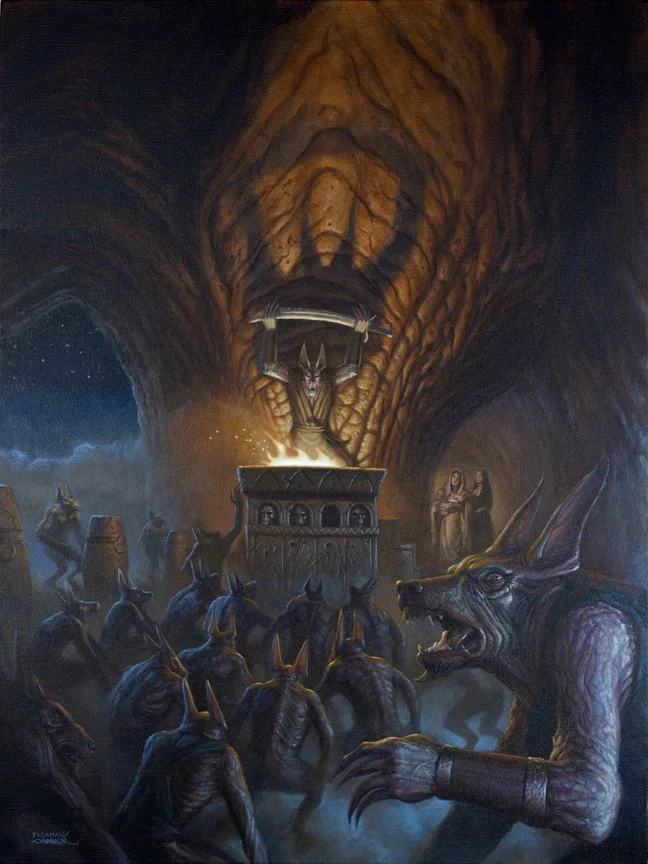
Al-Uqhad (“The Knot”), Artist Unknown
He is the DaVinci of darkness. The Goya of ghouls.
He is an artist as elusive as the subjects of his paintings.
I’m talking about Richard Upton Pickman.
Almost nothing is known about the man many people simply call “The Artist”. His legend casts such a shadow it’s hard to separate the man from the myth.
We do know that Pickman was born in Salem, Massachusetts in 1884. He came from an old, established family, though their reputation was marred by persecution. Richard’s great-great-great-great grandmother was executed during the Witch Trials in 1692. To this day, the family is still shunned in the community. Many descendants of the Pickman clan take great pains to conceal their identities to avoid attention, even going as far as to legally change their last names.
Because of his family’s reputation, rumors began to swirl around Richard Pickman from the moment he was born. Some claim the Pickman’s ‘real’ human child was kidnapped and a changeling put in its place, a ghoul-child the artist later featured in his work (and bore a strong resemblance to him). Even without the strange origin story, the boy stood out. Almost as soon as he learned to walk, he was known to escape his house and wander through graveyards. People on evening strolls often heard him among the crumbling headstones, babbling into the darkness. Some claimed they heard a gruff, barking voice respond to the boy. No one ever stepped foot into the cemetery to investigate.

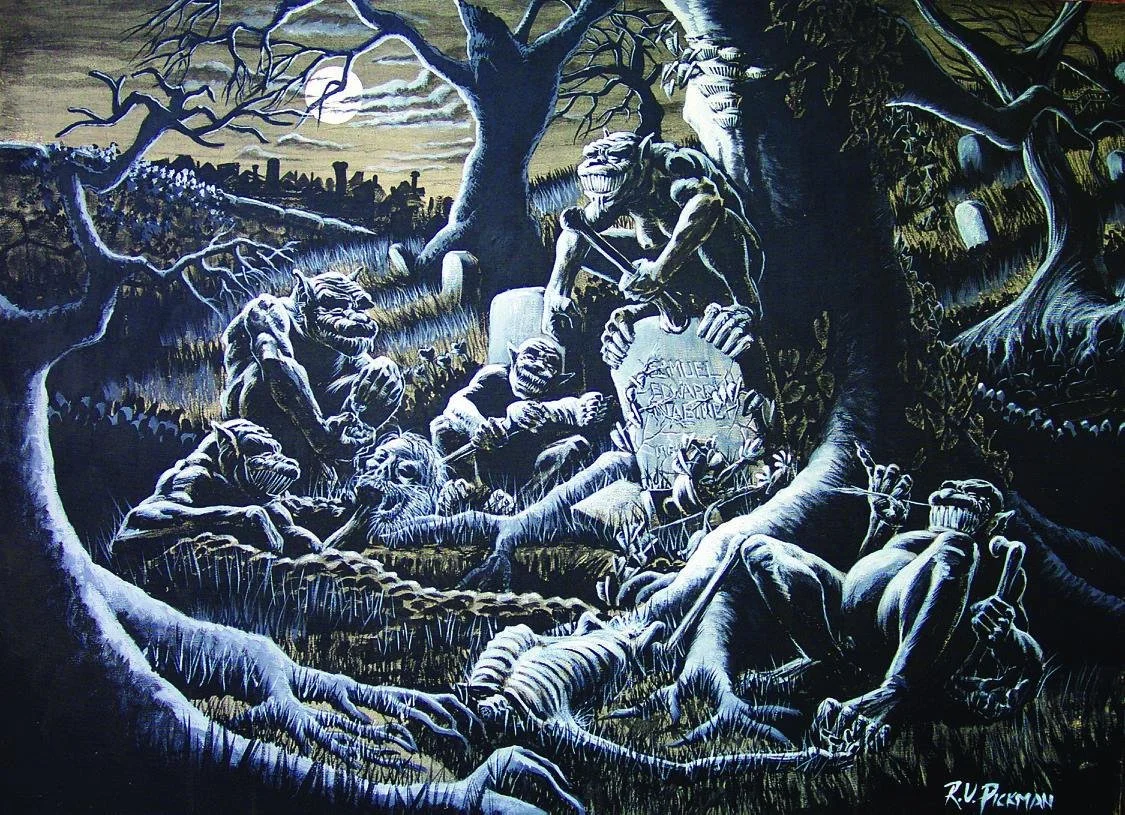
Ghoul Feeding (above) and Holmes, Lowell and Longfellow Lie Buried in Mount Auburn (right)
As soon as he started painting, it became clear that Pickman’s obsession with darkness continued into adulthood. None of his work survives but modern reproductions (all based on contemporary descriptions) suggest an almost satirical approach to these supernatural creatures. In Ghoul Feeding, the creatures in question lounge around the graveyard, relaxing after a big feast.
One even picks his teeth with a leftover bone.
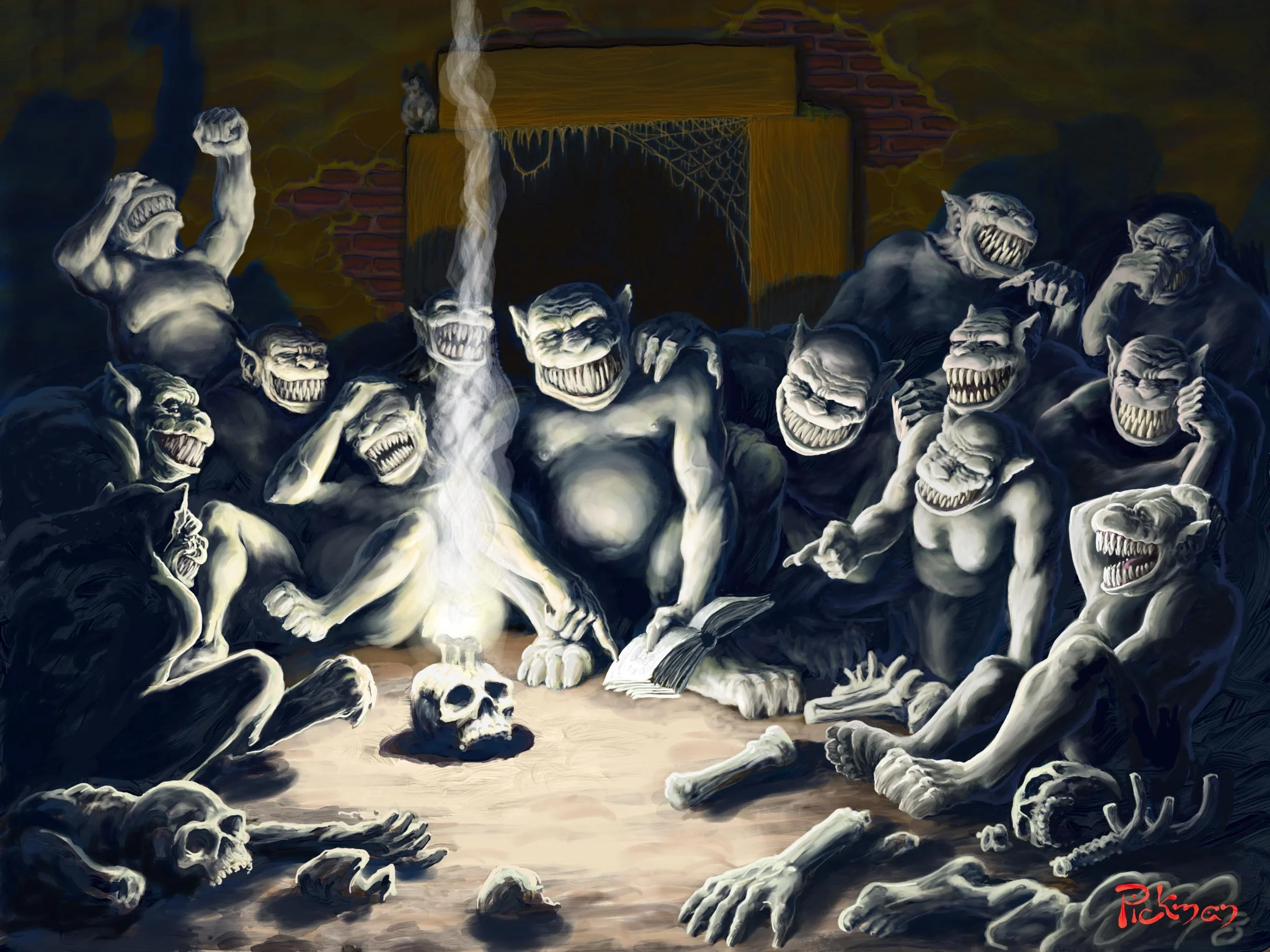
A similar fate seems to greet the bodies of physician Oliver Wendell Holmes and poets James Russell Lowell and Henry Wadsworth Longfellow in Holmes, Lowell and Longfellow Lie Buried in Mount Auburn. A group of ghouls snicker at a guidebook that tells tourists where to find the three men’s graves. Judging by the morsels in front of them, the bodies of the famous men are not in their final resting places.
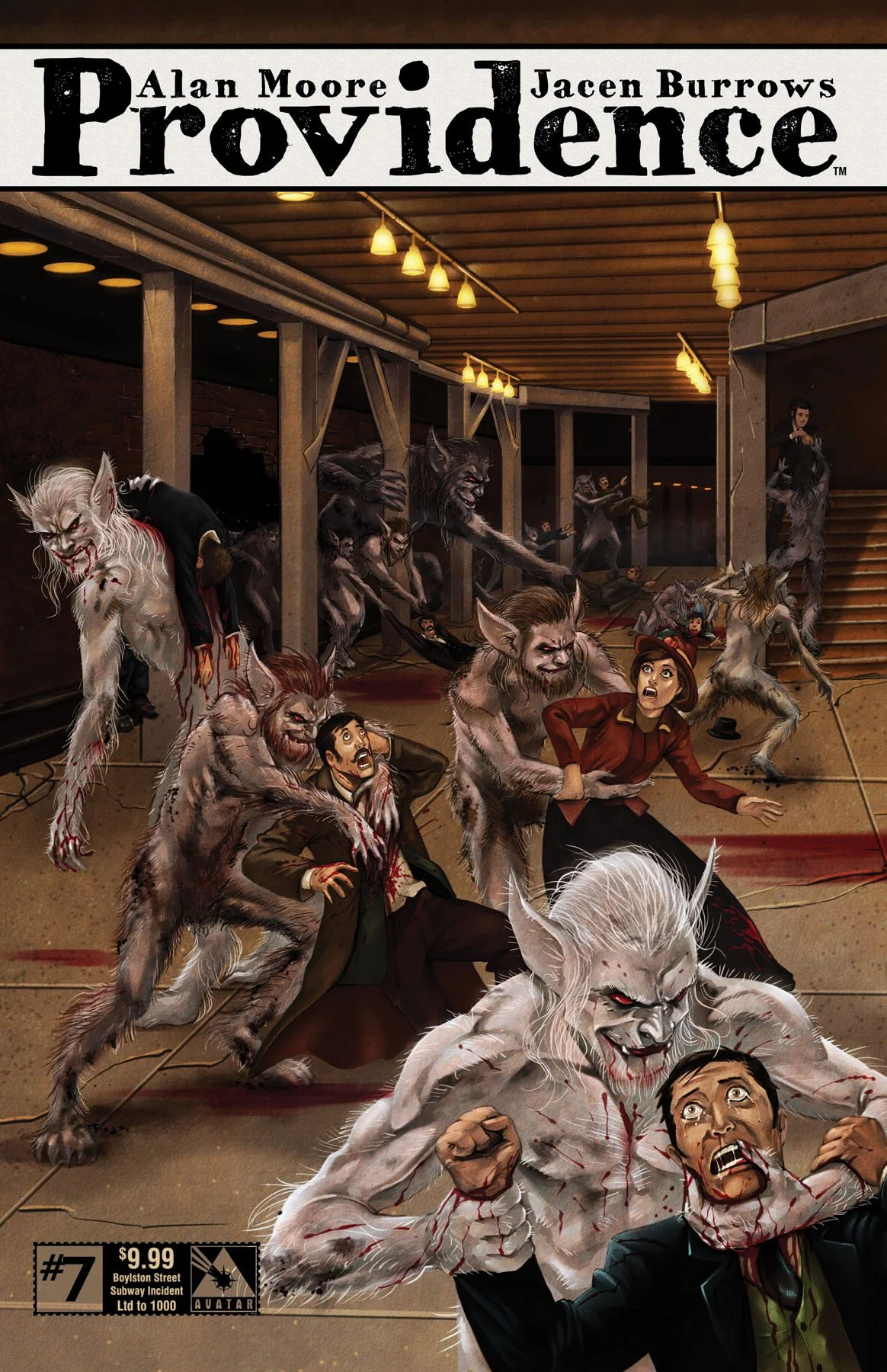
Subway Accident
In his most famous work Subway Accident, interpreted for Alan Moore’s graphic novel Providence, the fiends are shown in action, preying on the living that dare to venture underground. It was this macabre subject matter that got Pickman kicked out of both the Boston Art Club and the Museum of Fine Arts. One artist said that his art “repelled him more and more every day” and that Pickman was “a monster bound down the toboggan of reverse evolution.”
The criticism must have stung because shortly after the disastrous showing Richard Upton Pickman fled Arkham. It was rumored that during this time, he traveled, pursuing a lifelong dream to lay his hands on a copy of The Necronomicon.
No one knows what happened during his absence (or whether he found The Necronomicon). But when he returned from his self-imposed exile, he was a changed man. He embarked on what became known as his “soft heretic” phase. Gone from his canvas was the lurid, comic-book goriness.
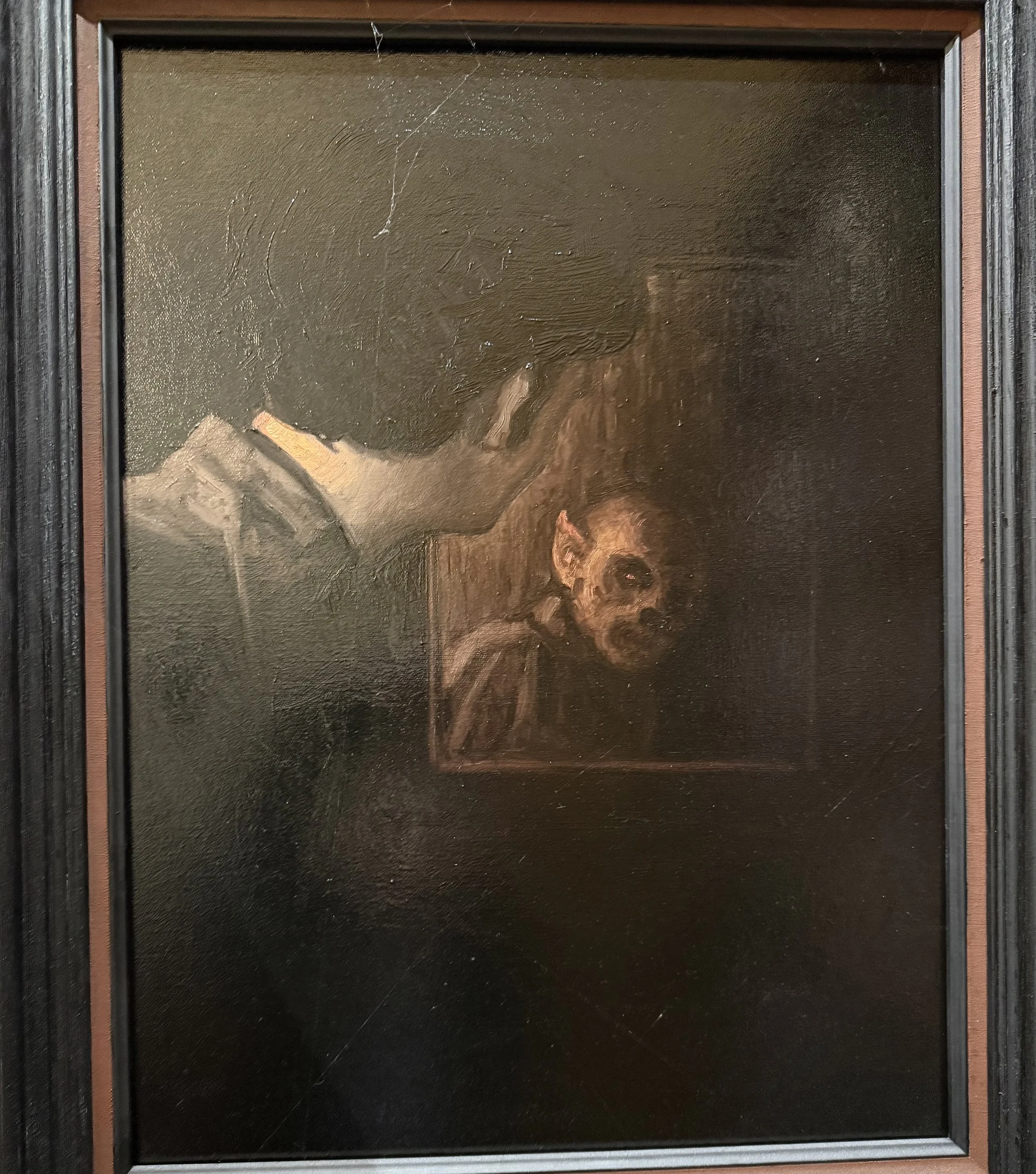
Self-Portrait, Max Martelli, Private Collection
In its place was a more nuanced, more introspective portrayal of the ghouls and their world.
The Lesson (like his other work, sadly lost) portrayed ghouls teaching their “adopted” human child how to feed like them. Another untitled work featured a Puritan father reading scripture to his family, one of whom is obviously a ghoul changeling.
But the most provocative piece (and the most intimate) is Self-Portrait.
Reproduced by Max Martelli, it shows Pickman looking into the mirror and seeing a reflection of his “true” self.
Al-Uqhad, Richard Upton Pickman, 1926 (?)
So why am I bringing this up? Why focus on an artist known more for his absence than his presence?
Because I may have discovered a new work by Richard Upton Pickman.
An original work, not simply one done by painters obsessed by “the artist”.
This piece of art was discovered in the basement of Edgewood Manor, a local retirement home in Arkham. In the 1920’s, it served as a boarding house for students of Miskatonic University. The location is significant because in the 1920’s, mathematician Michael Sloane set up residence there. It is not known how the two met, but Sloane and Richard Pickman decided to share a room in Edgewood, to cut down on their expenses.
Their partnership soon proved valuable in other ways. Richard Pickman produced this work while they lived together. One of the few works of art that is signed (and whose signature matches Pickman’s limited correspondence), it is titled Al-Uqhad, Arabic for the knot. This painting clearly comes from the artist’s “soft heretic” period, which ended in 1926 with his second (and final) disappearance.
The subject matter is unclear. Some sort of ritual is taking place because an altar fire has been lit. Fires at ghoul gatherings are unusual and only done when necessary (it takes ghouls days to recover from “light poisoning”). My suspicion is that the fires have been lit to welcome special guests. Standing just behind the altar, there are two human women with what is clearly a baby swaddled in cloth.
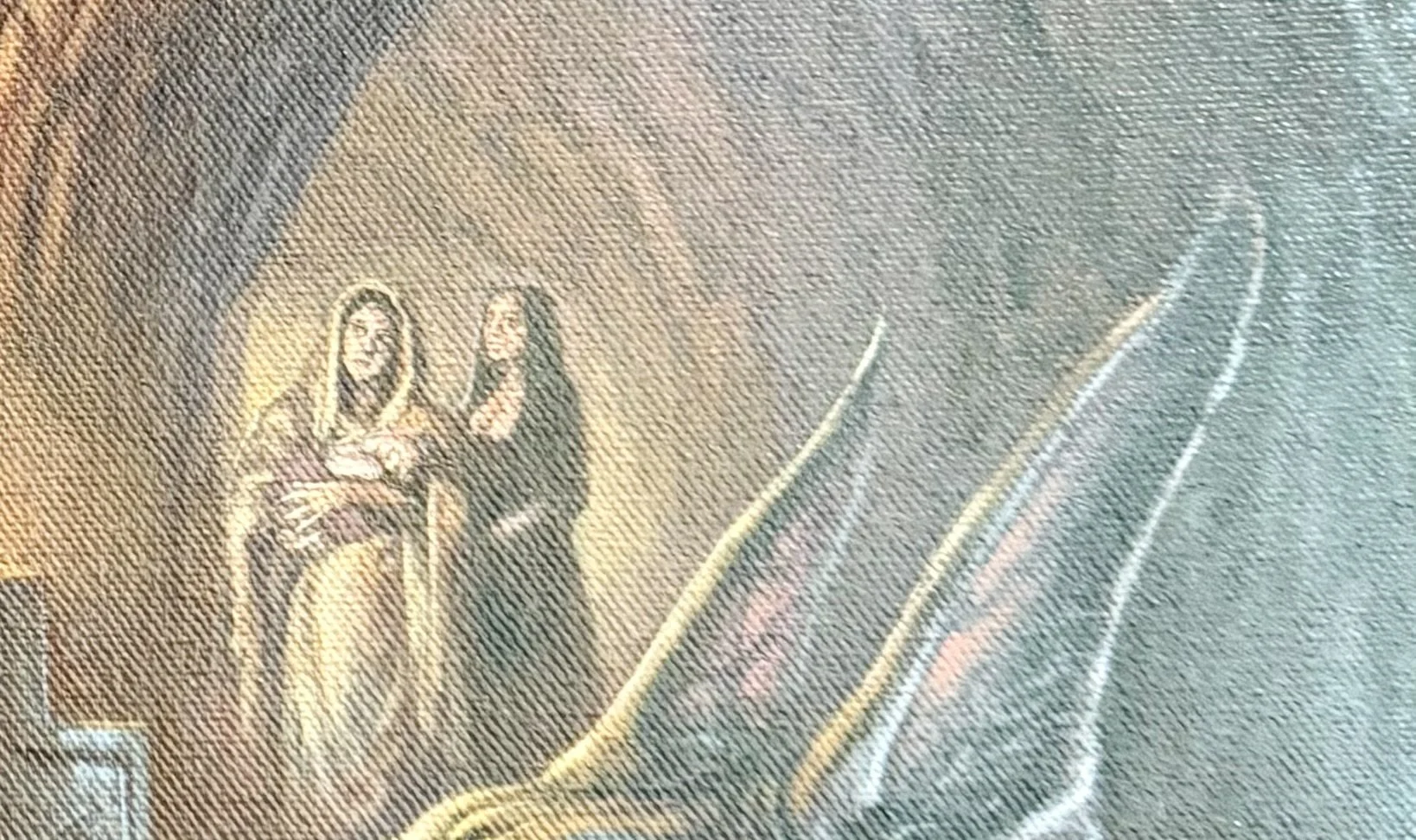
Al-Uqhad, Detail of Human Women & Baby
They are not being held against their will; there are no shackles holding them in place. They look at the ghoul leader not with horror but with expectation, even eagerness. There are no human men in attendance.
I think this last point, as well as the work’s title The Knot, is what suggests the painting’s meaning. With The Knot, Pickman is not trying to make monsters out of the ghouls but to point out similarities between us and them. Ghouls have a culture and a ritual that is obviously significant to them, one that requires an unusual group gathering (ghouls are normally very reclusive creatures).
And the human women who are watching from the sidelines?
I believe they are key to this ritual, the tie that binds.
I believe the child they are holding is both human and ghoul. A baby that brings together two very different worlds.
Such a suggestion would have been considered madness in Pickman’s time. But recent scholarship has revealed genetic inbreeding between early homo-sapiens and other species like Neanderthals and Denisovans. We still know almost nothing about ghouls as a species (we only just dismissed the idea that they were caused by a degenerative disease). Is it so outlandish to think that at some point in the distant past they may have been part of our family tree?
I am still conducting analysis on the material I managed to gather from the painting.
Unfortunately, The Knot was damaged in transit and shortly after its discovery, it vanished during an emergency evacuation of Arkham.
Its location is currently unknown.
Which only deepens the mystery around Richard Upton Pickman and his paintings…